
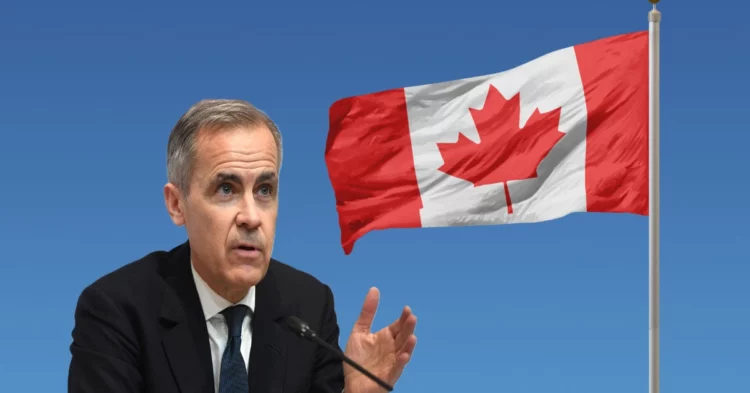
Prime Minister Mark Carney has announced a pause on Canada’s key electric vehicle (EV) sales target for 2026 while promoting a “Buy Canadian” policy, a move aimed at supporting domestic industries amid economic uncertainty and foreign trade pressures.
2026 EV Mandate Put on Hold
Under Carney’s announcement, Canadian automakers will no longer be required to ensure 20% of new car sales are electric in 2026.
- The original EV mandate was introduced in 2023 by Justin Trudeau.
- The long-term targets remain unchanged: 60% EV sales by 2030 and 100% by 2035.
- Ottawa will conduct a 60-day review of the EV mandate rules to assess potential adjustments.
Government figures show that zero-emission vehicles accounted for 11.7% of new car sales last year, indicating gradual adoption despite the paused mandate.
“Buy Canadian” Policy and Domestic Manufacturing Support
Carney emphasized prioritizing Canadian-made goods in federal contracts, alongside launching a fund to help firms develop new products.
“We cannot control what other nations do. We can control what we give ourselves—what we build for ourselves,” Carney said.
This policy is aimed at boosting domestic manufacturing and supporting industries affected by US tariffs and global trade pressures.
Economic Context: Job Losses and Trade Pressures
Canada’s economy is showing signs of weakening:
- 66,000 jobs were lost in August, primarily part-time positions.
- Unemployment rose to 7.1%, the highest since May 2016, excluding pandemic years.
Trade challenges have also impacted Canadian industries:
- US tariffs: 25% on foreign vehicles and 35% on Canadian goods (most exempt under the Canada-US-Mexico Agreement).
- China’s tariffs: 75.8% on canola seed imports, viewed as retaliation for Canada’s 100% EV tariffs on Chinese imports in 2024.
Carney indicated discussions with President Donald Trump were “good” and hopes to secure relief for affected sectors.
Political Reactions
- Conservative Party leader Pierre Poilievre criticized the decision as a “clumsy retreat,” claiming businesses may delay investment in Canadian auto manufacturing due to the uncertainty.
- Poilievre also noted that Carney had backed away from his previous stance of banning petrol and diesel vehicles by 2030.
What This Means for the Auto Industry
The pause on the EV mandate gives Canadian automakers more flexibility to navigate US tariffs and domestic economic pressures. However, it may also create short-term uncertainty for businesses planning long-term EV investments.
Domestic manufacturers now have an opportunity to benefit from federal support, including the Buy Canadian policy and development funds, while the government reviews long-term EV targets.
Key Takeaways
- The 20% EV sales target for 2026 is paused, while 2030 and 2035 targets remain.
- Ottawa will conduct a 60-day review of EV regulations.
- Carney introduces a Buy Canadian policy, prioritizing domestic products in federal contracts.
- Economic pressures, including US and China tariffs, are a key factor in the decision.
- The move aims to protect jobs, support domestic industries, and stabilize the Canadian auto sector.